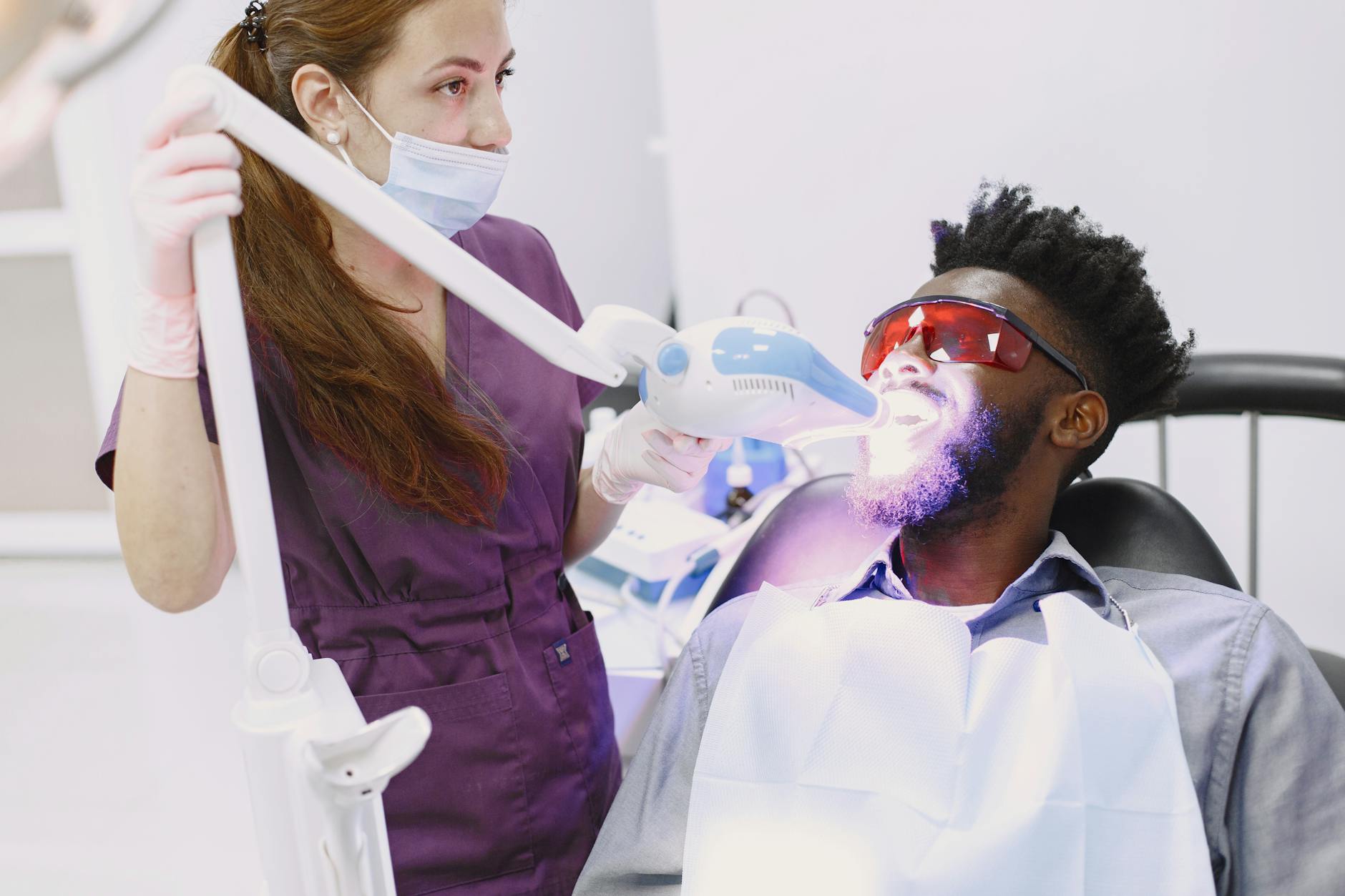
A patient came to me, Sofia, 28. She brought a bottle of some Brazilian gel marked «35% peroxide» that she had bought on Instagram for 40 euros. «Andrii, I want to whiten like a celebrity, the label says the result is as good as at the dentist». I looked at her teeth. Demineralised enamel, pink patches on the gums from uneven gel contact, sensitivity 9 out of 10. I said: «You already have a chemical burn. One more session with this gel and you'll be treating your gums for half a year».
16 years of practice have convinced me: 90% of whitening problems come from patients who did it at home without dentist supervision. The EU limited consumer gels to 0.1% peroxide for a reason. Anything stronger must be applied only by a doctor, with a rubber dam to protect the gums and monitored sensitivity.
Professional teeth whitening is called Zahnaufhellung or Bleaching in German. It is a controlled process of lightening tooth colour using peroxides under dental supervision. Whitening only works on natural tooth structure. Fillings, crowns, and veneers do not change colour. If you have visible restorations on your front teeth, they may look different after whitening.
Three whitening methods
In-office bleaching
The dentist applies a hydrogen peroxide gel (up to 6% under EU regulations since 2012) to the teeth. Gums are protected with a barrier. The procedure takes 60-90 minutes. Immediate result: lightening by 3-8 shades on the VITA scale.
Home bleaching (dentist-supervised)
The dentist makes custom trays. The patient applies carbamide peroxide gel (10-16%) at home, wearing the trays 2-4 hours daily or overnight for 2-3 weeks. Gentler process, equally effective long-term.
Over-the-counter products
Whitening strips and gels from drugstores (dm, Rossmann). Peroxide concentration is limited to 0.1% in the EU for non-prescription products. Minimal effect, but safe.
EU regulation
Since 2012, products containing more than 0.1% and up to 6% hydrogen peroxide may only be applied by dental professionals in the EU. This protects patients from gum burns and enamel damage.
When whitening is not recommended
Untreated cavities or leaking fillings
Peroxide can penetrate into the cavity and cause severe pain. Treatment first, whitening second.
Pregnancy and breastfeeding
No evidence of harm exists, but German guidelines advise against whitening during this time as a precaution.
Under 18 years old
The pulp chamber is still enlarged in adolescents, increasing the risk of nerve irritation.
How long do results last?
With good care, results last 1-3 years. Coffee, tea, red wine, and smoking shorten the effect. A touch-up treatment can be done after 6-12 months.
Tips after whitening
🦷 First 48 hours: avoid staining foods (coffee, soy sauce, berries)
🪥 Use a soft toothbrush and sensitivity toothpaste
🚭 Do not smoke for at least 48 hours
💧 Drink staining beverages through a straw
Real prices in Hamburg 2026
Many patients ask about cost. Here is the price range I use, in line with Hamburg averages.
In-office bleaching
One session 60-90 minutes, lightening 3-8 shades on the VITA scale. Cost 300-600 € depending on practice. I use the Opalescence Boost system with 40% hydrogen peroxide, chemically activated without a lamp. Lamps mostly act as placebo, increase temporary sensitivity, and offer minimal real benefit (Cochrane 2018).
Home bleaching with trays
Custom trays made (impression + lab), patient applies 10-16% carbamide peroxide gel for 4-8 hours daily or overnight, course 2-3 weeks. Cost 350-500 €. Slower but more stable and gentler on enamel.
Combined protocol
One in-office session + 1-2 weeks of home bleaching. Best balance of speed and stability. Cost 500-800 €. My preferred option for moderate to severe discolouration.
Internal bleaching (Walking Bleach)
For a devitalised tooth that has darkened after root canal therapy. Hydrogen peroxide is sealed inside the tooth, 3-5 sessions a week apart. Total cost 100-200 €. May be covered by GKV if justified as medically necessary.
5 whitening myths I hear every week
Marketing is stronger than science. That is why 80% of my patients arrive with wrong expectations.
Myth 1. «Activated charcoal whitens teeth»
No. It abrasively scrubs off surface stains, but at the same time wears down enamel. After 6-12 months of daily use, enamel thins, teeth look yellower because the dentin shows through. The result is the opposite of what was wanted.
Myth 2. «Coconut oil pulling whitens»
No effect on colour. A 2020 systematic review showed oil pulling has no significant impact on tooth shade. It may help hygiene a bit, but not whiten.
Myth 3. «Baking soda and lemon whiten»
Citric acid dissolves enamel (pH 2.0), baking soda scrubs it abrasively. The combination is a direct route to enamel erosion and hypersensitivity. Do not do this to yourself.
Myth 4. «I will get teeth like a Hollywood star»
Hollywood stars don't have natural teeth, they have veneers or crowns. The natural maximum is B1 on the VITA scale, noticeably darker than the «porcelain white» of Hollywood. That is the physiological limit, nothing changes it.
Myth 5. «One session and forever»
No. Maximum effect lasts 1-3 years. A touch-up with a tray every 6-12 months extends results. Without care, the original shade returns within a year.